It's the unfortunate truth: many unfunded proposals contain perfectly good science. They don't fail because the research is weak. They fail because the proposal talks about what excites the researcher rather than what the funder wants to achieve.
Luckily, the gap between "my great idea" and "an idea the funder wants to pay for" is often surprisingly small. Sometimes it's a matter of emphasis. Sometimes it's about using the funder's language instead of your own. Sometimes it's about making a connection explicit that you assumed was obvious. But if that gap isn't closed, reviewers notice, and they score accordingly.
The good news: closing that gap doesn't require changing your science dramatically. It requires understanding what the funder is really looking for, and then presenting your work through that lens.
I've had many ideas that excited me from a technical or disease-mechanistic perspective, that were rejected by funders. One proposal never reached the final defense stage until I submitted it for the third time. That time, I reframed the same scientific idea to explicitly address the funder's priorities, and suddenly it was the highest scoring proposal in the review panel.
Reading a grant call like a reviewer, not like an applicant
Most researchers read a grant call to extract practical information: what sections to write, how many pages, when it's due. That's necessary, but it's only the surface layer.
Grant calls contain at least three layers of information.
The first layer is the mechanics: sections, formats, word limits, eligibility criteria. This is what most people focus on.
The second is the stated priorities. These are what the funder explicitly says they want to fund. These are often written in outcome-oriented language: "advance understanding of," "develop solutions for," "accelerate translation of." These phrases are your alignment targets.
The third is the implicit values. These are what the funder rewards but doesn't always state directly. Does the call emphasize interdisciplinary collaboration? Patient involvement? Societal relevance? Economic impact? These values shape how reviewers interpret and score your content, even if they're not formally part of the scoring rubric.
What gets rewarded but isn't stated
What they explicitly want to fund
A strategic grant writer reads all three layers and uses them to frame their proposal. An average grant writer reads only the first.
Here's a practical technique: go through the grant call and highlight every phrase that describes what the funder wants to achieve (not what they want you to submit). These are your alignment anchors. Your proposal should echo this language, not by copying it, but by demonstrating that your research serves those goals.
Scientists think in science; funders think in outcomes
When you've spent years developing a novel methodology or investigating a specific mechanism, your natural instinct is to lead with what makes your approach scientifically interesting. Your internal narrative starts with the science and works outward.
Funders think in the opposite direction. They start with a problem they want solved or an outcome they want achieved, and they're looking for the most convincing path to get there. Your brilliant methodology is a means to their end, and your proposal needs to frame it that way.
This reframing feels unnatural for many researchers. It can feel like you're underselling the science or reducing complex work to simplistic outcomes. But it's not about simplifying. It's about contextualizing. You're showing the reviewer that your science doesn't just exist in isolation; it serves a purpose that matters to the funder.
Researcher
"My novel approach to X is innovative and technically challenging."
Your X advances
the funder's goal Y
Your X advances
the funder's goal Y
Funder
"We need solutions that address Y for society."
What GrantorAI extracts when you upload your grant call
When you upload your grant call documents to GrantorAI, the AI doesn't just extract a list of sections to fill in. It builds a strategic analysis of what the funder is looking for.
This analysis captures the layers we just discussed: the practical requirements, the funder's stated priorities, the evaluation criteria, and the strategic opportunities for positioning your proposal. It identifies what makes proposals competitive for this specific call, not generic grant writing advice, but guidance grounded in the actual document you uploaded.
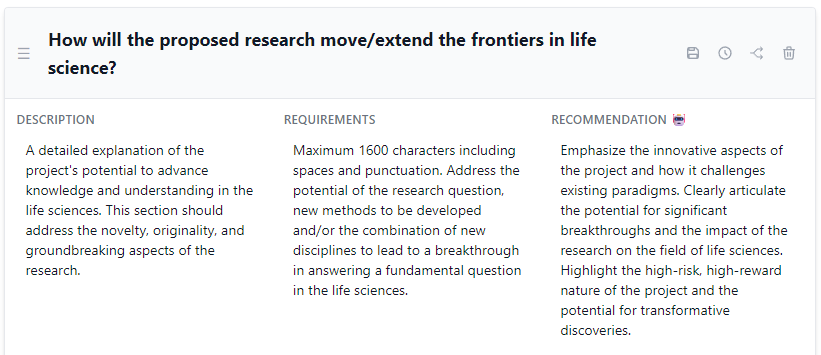
GrantorAI extracts funder priorities, evaluation criteria, and strategic opportunities directly from the call text.
This analysis serves as the foundation for everything else in GrantorAI. When the AI later generates content or provides feedback, it's always looking through this lens: does this serve what the funder is asking for?
But even before you write a single word, this analysis is valuable on its own. It gives you a strategic reading of the call that would otherwise take hours of careful study. Experienced grant writers develop this reading intuitively, but early-career researchers or those new to a particular funding body often miss it.
Your ideas, seen through the funder's priorities
In GrantorAI, your ideas are where your scientific thinking meets the funder's priorities. This is where you describe your research idea, your hypotheses, your methodology, your preliminary results, in whatever form makes sense to you. Finished paragraphs or rough bullet points, it doesn't matter.
What makes this step useful is the context: the AI already understands what the funder is looking for. So when you describe your approach, the system can identify where your ideas naturally align with the funder's priorities and where there might be gaps worth addressing.
Think of it as having a strategic advisor who reads your research notes while keeping the grant call open on their desk. They're not changing your science. They're helping you see which aspects of your work will resonate most with this particular funder.
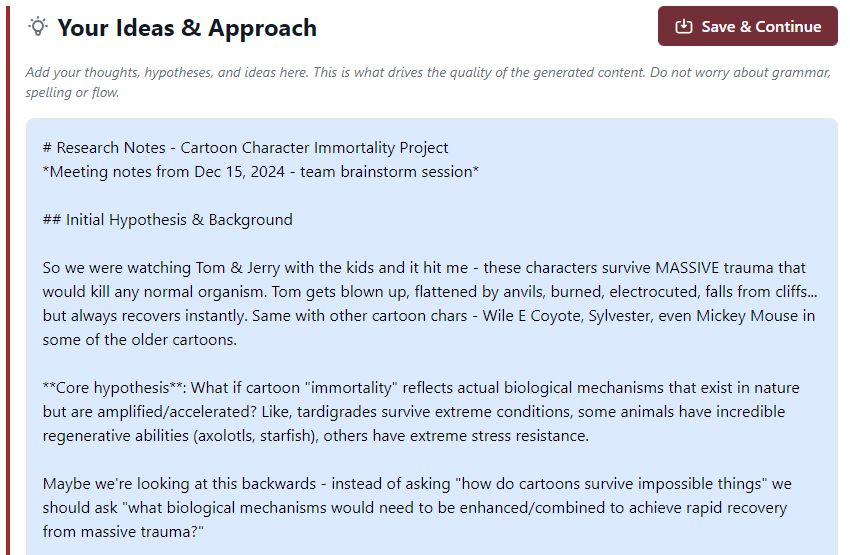
Your ideas, in your rough scientific thinking.
The question worth asking earlier
The single biggest improvement most researchers can make in their grant writing isn't better prose or more data. It's asking a different question.
Instead of "Is my proposal good?", ask "Does my proposal answer what this funder is looking for?"
These are not the same question. A proposal can be scientifically excellent and still miss the mark because it doesn't connect the dots for the reviewer. Funders don't fund good science in the abstract. They fund science that serves their mission.
Seeing your proposal through the funder's eyes from the very beginning, before you've committed hours to writing in a direction that doesn't align, is a much easier starting position than retrofitting alignment later.
In the next post, we'll look at how GrantorAI's feedback reads your draft against these same funder requirements, giving you the kind of critical, specific review that most researchers only get from the panel when it's too late to change anything.