There's a painful pattern in academic grant writing. You spend weeks drafting a proposal. You ask a colleague to review it. They skim it between meetings and say "looks good, maybe expand the methods section." You submit. Six months later, the review panel returns a page of specific, critical feedback pointing out gaps you didn't see, misalignment you didn't notice, and weaknesses you could have fixed if only someone had told you earlier.
The problem isn't that good feedback doesn't exist. But if the first good feedback comes from the reviewers, it's too late.
What if you could get that level of rigorous, detailed, requirements-grounded critique at every stage of your writing? Not once, but as many times as you need, each time you improve a section?
Why most proposal feedback falls short
Despite their willingness, colleagues and supervisors probably haven't read the grant call in detail. They can't evaluate whether your content actually addresses what the funder asked for. They tend to focus on what they know (the science) rather than what reviewers score on: alignment, completeness, structure, and persuasiveness. And they're human. They may not want to be too harsh, or are too much involved in the project, and you don't get the honest assessment you need.
Self-review is equally unreliable. You can't unsee what you meant to write. You know your methodology is sound, so you don't notice that you forgot to explain a crucial analysis step. You understand why your research matters, so you don't realize the impact section doesn't actually make the case.
Professional grant review services can provide thorough feedback, but they're expensive (often hundreds or thousands of euros) and slow. For many researchers, especially those early in their career or at institutions with limited budgets, they're simply not an option.
The ideal feedback partner would know the grant call inside and out, evaluate your content against those specific requirements, and give you concrete, actionable suggestions. Not vague encouragement. Specific direction.
Feedback grounded in what the funder actually asked for
GrantorAI's feedback system does something fundamentally different from a colleague skimming your draft. For each section of your proposal, the AI evaluates the content against the specific requirements of the grant call, the same requirements it extracted when you first uploaded the documents.
This means every piece of feedback is grounded in what the funder actually asked for. The AI doesn't just tell you whether your writing is clear. It tells you whether your writing addresses what needs to be addressed, in the way the funder expects it to be addressed.
The feedback is structured by impact. High-priority issues are the ones that could seriously hurt your score: a missing component that reviewers will flag, or a misalignment with a core funder priority. Medium-priority issues would strengthen your proposal if fixed. Low-priority items are refinements for polish. Every issue comes with concrete next steps, not "improve this section" but specific direction on what to add, restructure, or reframe.
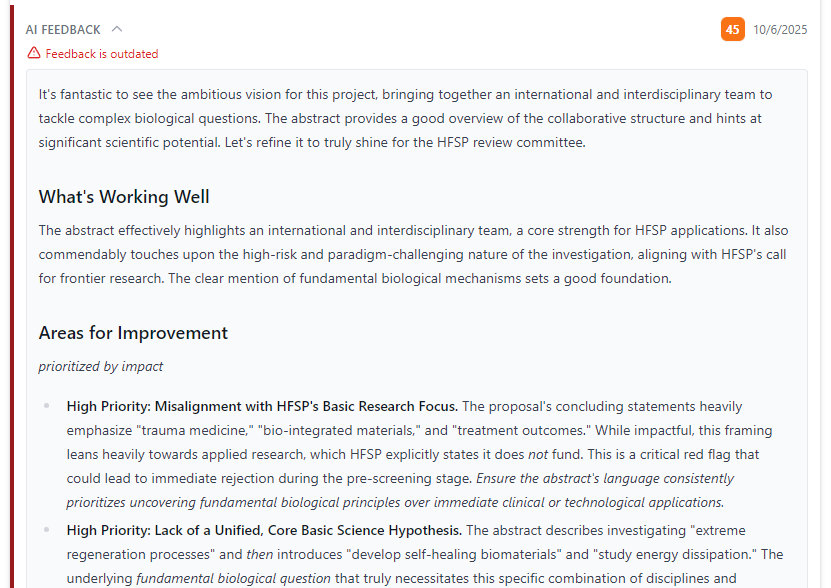
Detailed, requirement-grounded feedback shows you exactly where your draft aligns with the funder's priorities and where it falls short.
The score gives you an instant read on where you stand. But the real value is in the text: the detailed explanation of why you're at that score and what specifically to do about it.
Iterate as many times as you need
This is what users tell us they value most. You can generate feedback, improve your text based on the suggestions, and then ask for feedback again, as many times as you want. The AI doesn't get tired, doesn't get polite, and doesn't soften its assessment to spare your feelings.
Each cycle sharpens the section. The first round might score a 55 and flag fundamental alignment issues. You rewrite, incorporating the suggestions. The second round scores a 72 and now focuses on specificity and evidence. Another revision. The third round hits 85 and suggests minor refinements. You've gone from a weak section to a strong one through iterative improvement, the same process that experienced grant writers use, but with a reviewer available whenever you need one.
Round 1
Round 2
Round 3
Does your whole proposal tell one story?
Individual section feedback catches local problems. But some of the most important issues in a proposal are global: the narrative doesn't hold together across sections, the methodology doesn't quite deliver what the objectives promise, or the impact section makes claims the approach can't support.
GrantorAI's mock review panel reads your entire proposal the way a committee would. Three virtual reviewers each read all your sections together and write their review; a chair then weighs the three and gives the panel's verdict: a score, the bottom line, what the reviewers agreed on and where they split, and what to fix first.
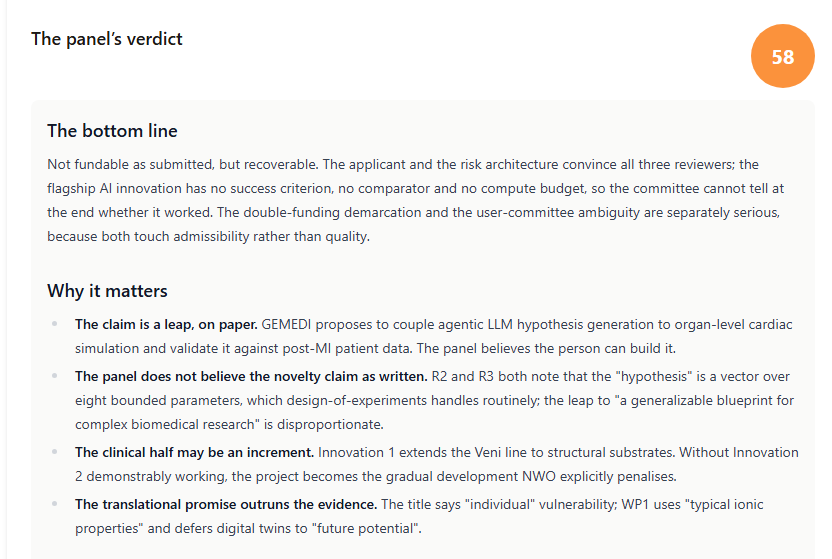
The mock review panel catches the coherence problems that feedback on one section at a time misses: does the story hold together from start to finish?
This top-level view catches the kind of coherence problems that are invisible when you're reviewing one section at a time but obvious to a reviewer reading the complete proposal.
A better starting point for your colleagues
Here's the practical payoff that goes beyond the AI: by the time you share your proposal with colleagues, it's already been through multiple rounds of rigorous review. Your colleagues receive a strong draft to refine, not a rough draft to fix.
This changes the nature of their contribution. Instead of catching basic gaps and alignment issues (which the AI has already surfaced), they can focus on what humans are uniquely good at: evaluating whether the science is compelling, whether the team composition makes sense, whether the preliminary data tells the right story. You're using their expertise where it matters most.
And when they do provide feedback, GrantorAI gives them structured tools to do it. Colleagues can leave comments on specific sections with threaded discussions, keeping feedback organized by topic rather than scattered across emails. They can even make tracked-change-style suggestions directly in your text: insertions and edits you can review and accept or reject individually, just like you would in a word processor.
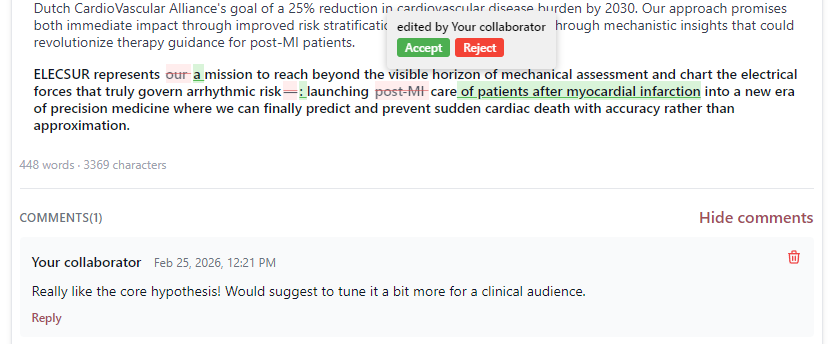
Collaborators can suggest specific text changes and leave comments, turning feedback into a structured review process rather than a chaotic email chain.
The result: a structured review trail instead of a folder of email attachments with conflicting suggestions.
The compound effect
Each round of feedback (whether from the AI or from colleagues) makes your proposal better. But the compound effect of multiple rounds is what produces truly competitive proposals. The AI catches what you can't see yourself. You improve the content. The AI catches the next layer of issues. You refine further. By the time a colleague reads it, the obvious problems are already fixed. Their feedback takes you from good to excellent.
Most submitted proposals have been through one or two informal reviews. Yours has been through as many critical evaluations as it took to get it right.
Next, we'll look at how GrantorAI helps you go from blank page to structured first draft, because the hardest part of grant writing is often just getting started.