There's a specific kind of dread that most researchers know well. You've read the grant call. You have ideas. Good ones. Maybe some preliminary data, some notes from a brainstorm, fragments from a previous proposal. But the call asks for twelve different sections with specific requirements, and somehow you need to turn your scattered thinking into a coherent, compelling document.
So you open a blank Word document. And you stare at it.
Grant writing paralysis is real, and it's not about laziness or lack of ideas. It's about the sheer cognitive load of simultaneously thinking about what to say, how to structure it, what the funder wants, and how it all fits together. The blank page asks you to do everything at once.
There's a better way to start.
Structure first, prose second
The best grant writers don't write linearly from introduction to budget. They start by understanding the container: what sections exist, what each section needs to accomplish, what the constraints are, how sections relate to each other.
This structure-first approach works because it breaks an overwhelming task into manageable pieces. Instead of writing "a grant proposal," you're writing a 300-word impact statement, then a 500-word methodology description, then a budget justification. Each piece has clear boundaries and specific requirements. That's much easier to think about than a monolithic document.
It also prevents a common problem: spending three pages on your scientific approach only to discover that the form only allows 400 words for that section, while the "societal relevance" section you planned to dash off actually needs 600 words and is weighted heavily in the scoring.
Structure gives you a map of the territory before you start the journey. Without it, you're navigating by feel, and you'll almost certainly take wrong turns.
From grant call to structured workspace in minutes
This is one of the most immediately useful things GrantorAI does. When you upload your grant call and submission form, the AI extracts every form element (each section you need to fill in), along with its title, description, requirements, character or word limits, and any specific conditions.
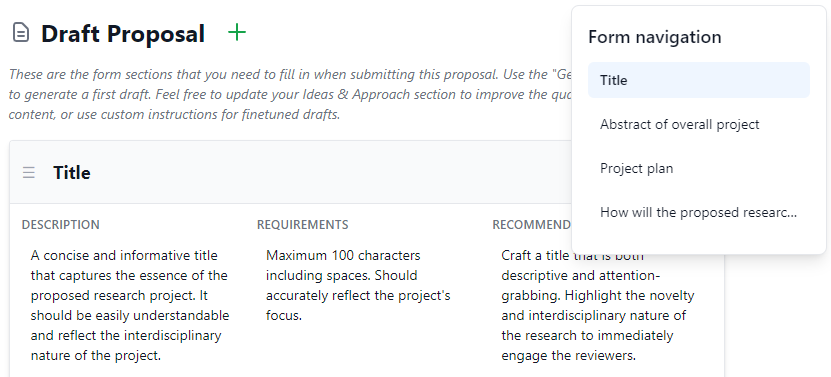
GrantorAI breaks down the proposal into specific fields, extracting requirements and providing strategic recommendations for each one.
This isn't just time savings, though it certainly is that. It's a different starting point for your thinking. Instead of staring at a blank document wondering where to begin, you're looking at a structured framework that shows you exactly what needs to be written, where, and under what constraints. The overwhelming task of "write a grant" becomes a series of specific, bounded tasks.
Brain dumps are fine - organized input is not required
Here's where we address the other half of the blank page problem: not just "where do I write?" but "how do I turn my messy thinking into coherent text?"
“The first draft of anything is shit.” - Ernest Hemingway
In GrantorAI, your ideas can be in any state of organization. You can write finished paragraphs if you have them, but you can also dump in bullet points, half-formed thoughts, notes from lab meetings, fragments of ideas you're still deciding between. You don't need to organize your input, because the AI will organize the output.
This matters more than it might seem. The pressure to write well from the start creates its own kind of paralysis. If your internal standard is "every sentence I write should be proposal-ready," you'll write very slowly and delete a lot. But if the input is just for you, a brain dump that the AI will reshape, you can get your ideas down quickly without worrying about polish.
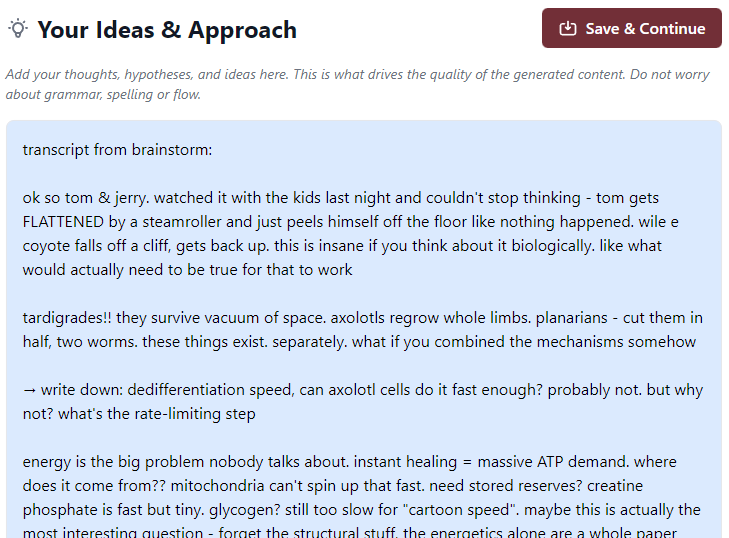
Your ideas are for your raw thinking. Dump in bullet points, questions, and rough notes; a draft gives them structure.
A first draft you can react to, not create from nothing
I continue to be amazed how well AI can organize and rephrase my thoughts. It can identify the core argument running through my scattered notes, organize supporting points into a logical flow, and produce structured prose that reads as a deliberate, well-planned narrative. And I've discovered something else: if AI can't organize my thoughts, it is often because there is a gap in my reasoning, which I can then need to address.
This highlights another important principle: editing is dramatically easier than creating. Having something on the page (even if it needs significant revision) gives you a concrete starting point. You can sharpen arguments, add specifics, redirect emphasis, restructure paragraphs. You're reacting and improving, not creating from nothing.
When you generate content in GrantorAI, the AI takes your ideas, the funder's requirements, and the specific section constraints, and produces a complete draft for each element. This draft is informed by everything the system knows: what the funder is looking for, what your research is about, and what this particular section needs to accomplish.
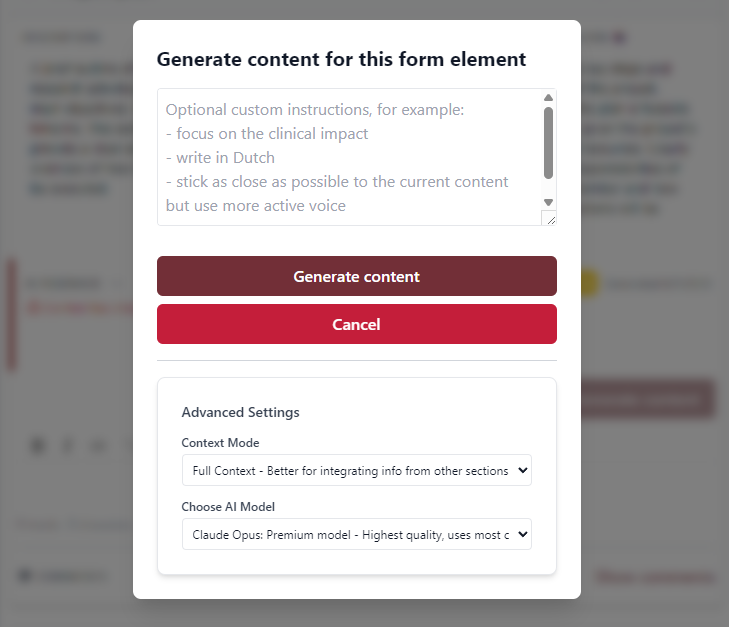
Generate a first draft in seconds, then refine it with custom instructions like "focus on clinical impact" or "shorten this section."
A starting point for reactive iteration
The generated content isn't meant to be the final version. It's a starting point: a first draft that's already structured, aligned with requirements, and written in professional grant language. From here, you can edit directly, provide custom instructions to redirect the AI ("make the methodology more specific about the statistical approach" or "emphasize the clinical relevance more"), or regenerate entirely with a different emphasis.
The iterative cycle of generate → review → instruct → regenerate is where the real value lies. Each cycle gets closer to what you actually want to say, and the process often clarifies your own thinking about what that is. And you can do the rewriting yourself, or give the AI specific rewriting instructions: "rewrite this section to be more specific about the statistical approach" or "emphasize the clinical relevance more".
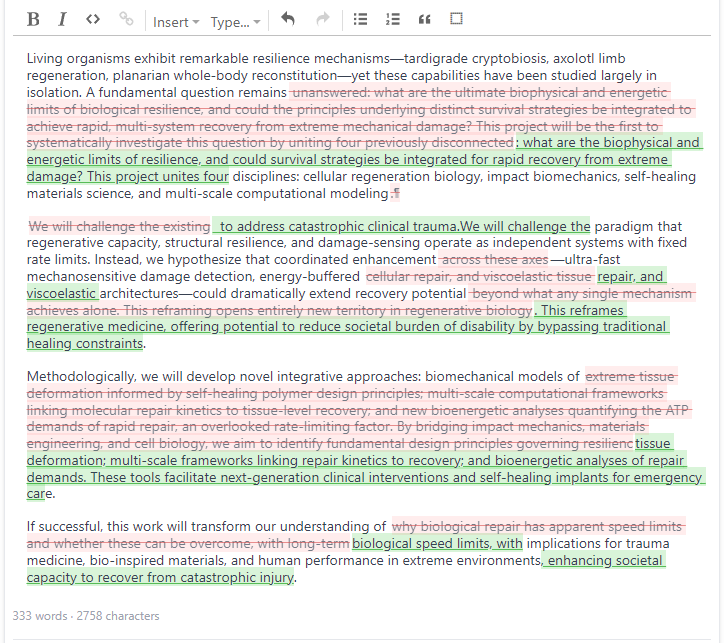
Iterative refinement in action: requesting the AI to focus more on clinical and societal impact leads to specific, tracked suggestions that reshape the narrative.
Structure organizes your thinking, not just your words
Something interesting happens when researchers use this workflow: the structure doesn't just organize their writing. It organizes their thinking.
Seeing your scattered ideas mapped onto specific proposal sections reveals things that aren't obvious when everything lives as notes in your head. Gaps become visible: you know your methodology cold, but you haven't really thought through the dissemination plan. Connections emerge: a point you made in your notes actually serves the impact section better than the approach section. Sometimes entirely new angles appear: organizing your ideas against the funder's structure shows you a framing of your research you hadn't considered before.
This is the underappreciated benefit of starting from structure rather than starting from prose. The structure isn't just a container for your words. It's a thinking framework that helps you develop a stronger proposal at the level of ideas, not just sentences.
Your ideas
novel method for data analysis...
prelim data
check with Maria regarding timeline
3 work packages?
impact: clinical use case
2 postdocs
Your proposal
From days to hours
Traditional grant writing timelines often look like this: a few days to read and understand the call, a week or more to write the first draft, then multiple rounds of revision. The first draft phase is typically the most painful and the least productive per hour invested, because so much mental energy goes into structure and organization rather than substance.
With a structure-first approach powered by AI, that timeline compresses dramatically. You upload the call and get a structured workspace in minutes. You pour your ideas in, messy, incomplete, however they come, and generate a first draft within an hour. The rest of your time goes to what you're actually good at: refining the science, strengthening the arguments, and making the proposal distinctly yours.
Having a first draft is just the beginning. In our post on getting honest feedback, we cover how to use GrantorAI's feedback to improve your proposal step by step before anyone else sees it.