Two weeks until the deadline. A half-finished proposal. Twelve sections that all need attention. Where do you spend your time?
If you're like most researchers, you'll do one of two things. You might work linearly from top to bottom, giving each section roughly equal attention, and run out of time before the most important sections are properly finished. Or you might gravitate toward the sections you enjoy writing: the detailed methodology, the technical innovation, the elegant experimental design. Meanwhile, the impact statement, the risk mitigation plan, and the project management section (the ones that feel boring but that reviewers actually score against) get written in a rush on the final day.
Neither approach makes the best use of your time. The 80/20 principle holds for grant writing too: a small number of improvements will have an outsized effect on your overall score.
The load-bearing sections versus the rest
Every grant call has its own evaluation criteria, but certain patterns hold across most funders. The sections that typically carry the most weight are the scientific approach or methodology, the alignment with the call's priorities, the feasibility and planning, and the expected impact. These are the "load-bearing walls" of your proposal.
Administrative sections, detailed timelines, and data management plans matter. A sloppy timeline can raise doubts about your planning, but these sections rarely make or break a proposal on their own. A reviewer might note a weak data management plan but still recommend funding if the science and impact are compelling. They will almost never recommend funding if the methodology is unconvincing, no matter how well written the rest of the document is.
The strategic grant writer identifies which sections are load-bearing for a specific call and invests disproportionately there. This doesn't mean ignoring other sections. It means being deliberate about where your revision energy goes.
Where reviewers focus
approach
impact
Mgt.
Your score distribution as a triage tool
Here's where this principle moves from abstract advice to a concrete tool. When you ask for editorial feedback on your proposal's sections in GrantorAI, the scores create a heat map of your proposal's strengths and weaknesses.
A section scoring 85 or above is probably in good shape. It may benefit from minor refinements, but spending another two hours on it won't dramatically change its impact on reviewers. A section scoring 55, on the other hand, is where reviewers will focus their criticism. That's where your time belongs.
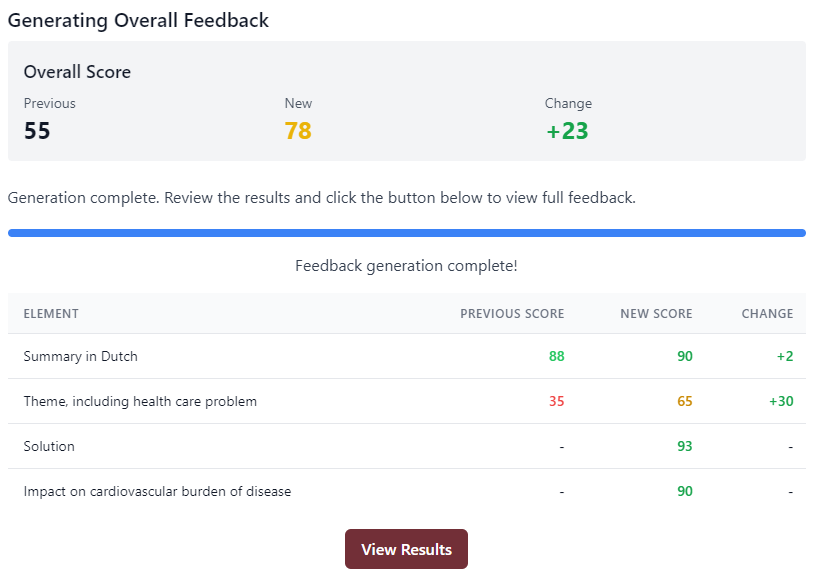
Scores act as a heat map for your proposal. A low score on a key section is an immediate signal: spend your time here, not polishing the introduction again.
What reviewers are trained to find - and what the AI finds first
The scores alone are useful for triage, but the feedback text tells you something more important: why a section is scoring low and what specifically to do about it. Is it a content gap? An alignment problem? A structural issue? Missing evidence?
Because of the time-consuming nature of grant reviewing, experienced grant reviewers love to spot what's missing. A methodology that doesn't explain the statistical analysis. An impact section that claims societal benefit without quantifying it. A budget that includes a postdoc position but doesn't justify why a postdoc is needed. These gaps are easy to miss when you're the author, because you have the answers in your head. You just didn't write them down.
This is one of the most valuable things the editorial feedback catches. Because it reads your text the way a reviewer would, it notices when something that should be explicitly stated is only implied or missing entirely.
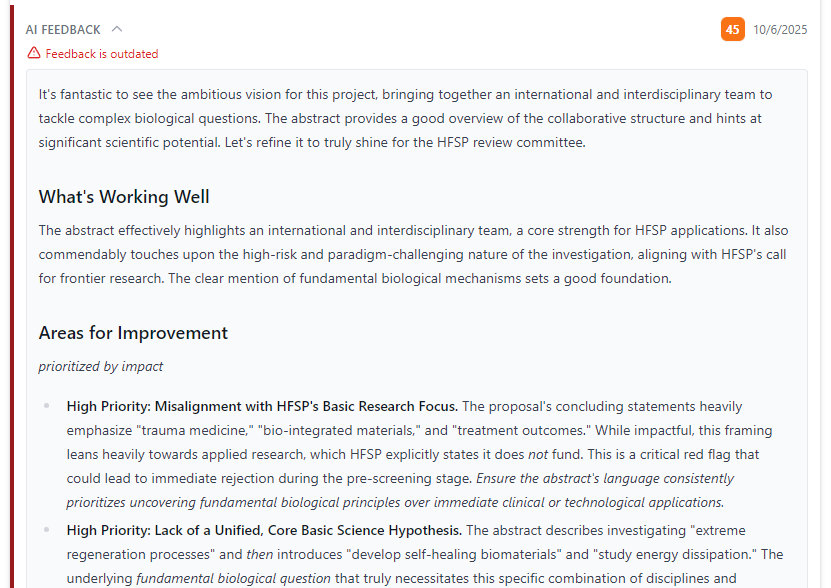
A low score often indicates a missing component that reviewers are trained to look for. Fixing these gaps yields the highest return on your revision time.
These findings are disproportionately valuable. Filling a gap that a reviewer would have flagged as a major issue has a much larger effect on your score than polishing a paragraph that's already solid.
The scientist's trap: polishing what you love
There's a specific pattern that's worth being aware of, because it affects nearly every researcher at some point.
Scientists naturally spend the most time on the parts of a proposal they're passionate about. The detailed methodology. The technical innovation. The clever experimental design. These sections often end up over-written (more detail than the funder asked for, more length than the word limit comfortably allows) while sections that feel less exciting get rushed.
But reviewers evaluate against the grant call's requirements, not against your research interests. A brilliant methodology section can't compensate for an impact section that reads like an afterthought.
The editorial feedback helps correct this natural bias. It evaluates every section against the same standard: the funder's requirements and priorities. It doesn't care which section excites you. It cares about what the call asks for. If your methodology scores 88 but your dissemination plan scores 52, the feedback makes that imbalance visible, and actionable.
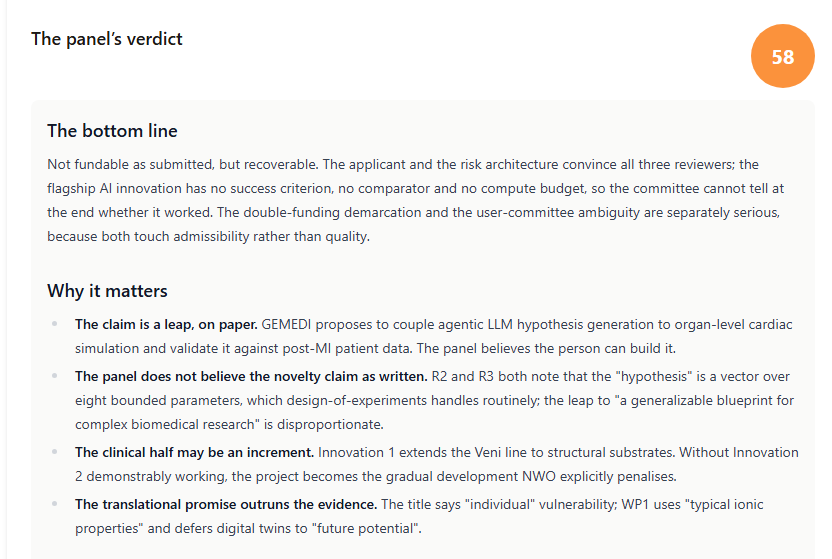
The mock review panel reads the whole proposal, so it sees the imbalance. If your scientific approach is stellar but your impact section is weak, its verdict tells you where to move your effort.
A practical prioritization workflow
Here's how to put the 80/20 principle into practice with GrantorAI:
Step 1: Get the full picture. Generate feedback on all sections of your proposal. This gives you a complete view of where you stand, not just the section you happened to reread last.
Step 2: Sort by impact. Look at the scores and the priority levels of the issues. Sections with low scores and high-priority issues flagged are where you'll get the most return on your time.
Step 3: Fix the biggest gap first. Open the lowest-scoring section with the most critical feedback. Read the specific suggestions. Make the changes. This might take 30 minutes or two hours, but it will likely improve your proposal's overall competitiveness more than any other single action.
Step 4: Verify the improvement. After editing, do not just regenerate the feedback, but really do some introspection: Is this really an improvement? Don't overly focus on AI scores!
Step 5: Move to the next priority. Work through sections in order of impact, not in order of the document. By the time you've addressed the high-priority issues in your three weakest sections, your overall proposal quality has likely improved more than it would have from a complete linear revision.
This workflow helps most when time is limited, which in grant writing is almost always the case. You're making strategic choices about where to invest your effort, guided by concrete data rather than instinct.
Knowing when to stop polishing
The 80/20 principle has a corollary that's equally important: once a section is strong, let it go.
Perfectionism is a real trap in academic writing. You can always find something to improve, always rework a sentence, always add one more reference. But past a certain point, these refinements don't change the outcome. A section scoring 88 that you revise to a 91 hasn't changed anything. The two hours you spent on it could have brought a 55 up to a 75, which absolutely changes the outcome.
The feedback scores help you make this call. When a section is consistently scoring well and the remaining suggestions are low-priority refinements, it's time to redirect your energy. Your proposal doesn't need to be perfect. It needs to be strong where it matters.
Grant writing is hard enough without spending your effort in the wrong places. Focus on the sections that will move reviewers, fix the gaps they'll look for, and know when to stop polishing. Your limited time deserves a strategy.