If English isn't your first language, you already know this feeling: you have a clear, compelling research idea in your head, but somewhere between your thoughts and the written proposal, something gets lost. The argument that felt sharp becomes slightly blunt. The phrasing that would be natural in your language sounds awkward in English. The subtle difference between "we will investigate" and "we aim to elucidate" (one sounds confident, the other sounds like you're trying too hard) isn't something anyone teaches you.
This isn't about intelligence or scientific quality. It's about the gap between thinking in one language and writing persuasively in another. And in grant writing, where every word counts and reviewers form impressions quickly, that gap can be the difference between funded and unfunded.
The uncomfortable reality is that the current system gives native English speakers a built-in advantage, not because their science is better, but because their proposals read better. That's not a fair basis for funding decisions, and as a non-native speaker myself, it was one of the reasons I built GrantorAI.
The deeper challenge isn't grammar
When people talk about non-native English writing challenges, they often focus on grammar: awkward verb tenses, article usage, preposition choices. These are real issues, and spell-checkers and grammar tools can help with them. But the deeper challenge in grant writing isn't grammar. It's rhetoric.
Effective grant writing requires a specific type of persuasive academic English that's difficult to learn even for native speakers. It involves knowing when to be assertive and when to hedge, how to frame significance without sounding grandiose, how to acknowledge limitations without undermining confidence, and how to strike the tone that reviewers expect from a credible, professional proposal.
For researchers who did their education in a different language, or who work in environments where English is used for writing but not for daily communication, these conventions are largely invisible. You might write a perfectly grammatical proposal that still feels slightly off to a native-English reviewer, and that feeling affects scoring, even if reviewers don't consciously recognize why.
Think in your best language; write in the funder's
One of the most practical pieces of advice for non-native speakers: separate the thinking from the writing. Don't try to simultaneously develop your scientific argument and express it in finished English. These are two different cognitive tasks, and doing them at the same time slows you down and degrades both.
Think in whatever language works best for you. Sketch your arguments, your methodology, your preliminary results in the language of your internal monologue, whether that's full sentences in your native language, a mix of languages, or rough English notes. Focus on the substance: what is your idea, why does it matter, how will you do it, what will it achieve.
Then, as a separate step, transform that thinking into well-written English.
This is exactly what GrantorAI enables. Your ideas don't need to be in good English. They need to contain your scientific thinking, the substance of what you want to propose. The AI takes that substance and drafts it, aligned with the funder's requirements and conventions, in clear academic English, so reviewers judge the science, not your grammar.
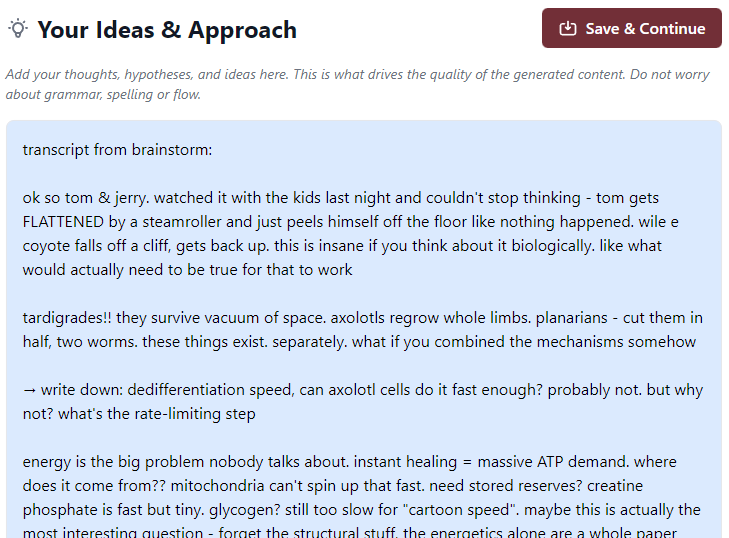
Write your ideas in rough English, bullet points, or mixed languages. The AI drafts your scientific thinking in clear academic English, so reviewers judge the science, not your grammar.
The result is a proposal that reviewers can read without stumbling over the language. Yes, you'll want to edit it and make it your own, but it's a good starting point.
The resources gap that makes this matter
Researchers at well-funded institutions may have access to professional grant writing services or experienced colleagues who can review and polish their English. These resources are expensive. Professional grant writers typically charge thousands of euros, and access to them correlates strongly with institutional wealth and location.
This creates a compounding inequality. Researchers at wealthy institutions write better proposals, which win more funding, which makes their institutions wealthier, which gives them more access to grant writing support. Meanwhile, equally talented researchers at less-resourced institutions, particularly in countries where English isn't the primary academic language, face an uphill battle with every application.
GrantorAI costs a fraction of what professional grant writing services charge, and it's available to anyone with an internet connection. Unfunded researchers can access basic features for free. The playing field isn't perfectly level (it never will be), but the language advantage that well-resourced institutions have enjoyed is significantly reduced.
Not just writing in English - writing for the funder
Generic language correction tools can fix your grammar and suggest more natural phrasing. That's useful, but it's not enough for grant writing. A grant proposal needs to be written in language that serves a specific purpose: convincing this specific funder that your research deserves their funding.
Because GrantorAI has analyzed the grant call requirements, its generated content doesn't just use correct English. It uses the right kind of English for the context. It echoes the funder's terminology and values. It structures arguments the way reviewers expect for that particular scheme. It calibrates the level of assertiveness and the type of evidence that the call rewards.
This is the difference between running your proposal through a grammar checker and having a knowledgeable, strategic writing partner who understands both your science and the funder's expectations.
Great science deserves a fair shot
Every year, excellent research ideas go unfunded because the proposal didn't read well enough in English. Every year, native speakers have an unearned advantage in a process that should be about scientific merit, innovation, and potential impact.
I can't fix every source of inequality in the academic funding system. But I developed GrantorAI to make sure that the quality of your grant writing reflects the quality of your thinking, regardless of which language you think in.
GrantorAI helps you express your scientific ideas in professional, funder-aligned English. Your research speaks for itself, and the AI just helps it speak in the right language.